
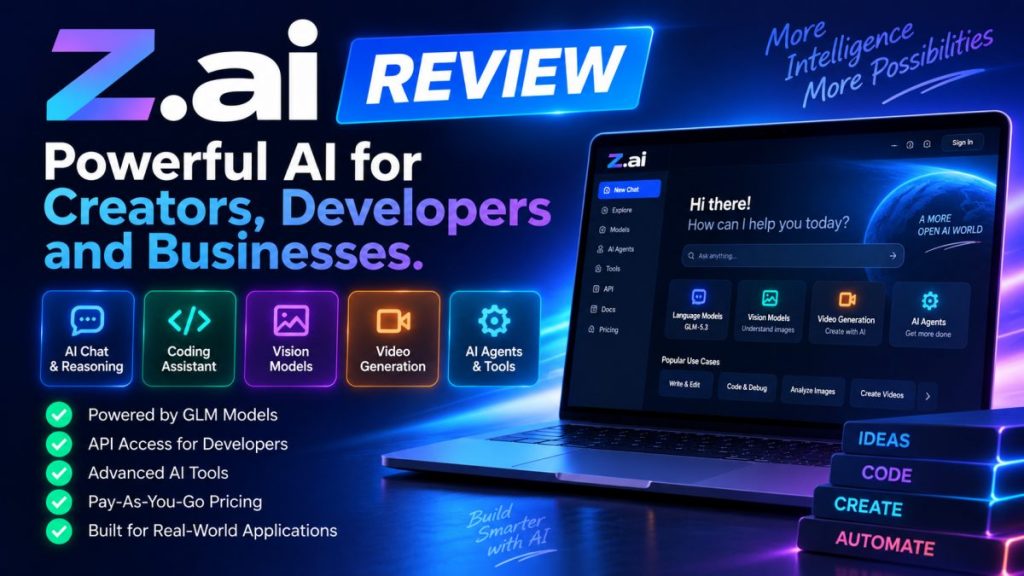
Z.ai Review: Is This AI Platform Worth Using?

AI assistants are becoming increasingly capable, but choosing the right platform can be difficult. There are now dedicated tools for writing, coding, research, image understanding, automation and developer workflows.
Z.ai takes a broader approach. Built around the GLM family of AI models, the platform combines AI chat, reasoning, coding capabilities and developer tools in one ecosystem.
For developers, Z.ai also provides API access to its models, while its broader product ecosystem includes tools designed for agentic workflows and software development.
The important question is not simply whether Z.ai can generate a good answer.
Can it become a useful part of your everyday AI workflow?
Quick answer: Z.ai is worth exploring if you want an AI platform focused on the GLM model family, coding, reasoning, developer workflows and API access. It can be particularly interesting for developers and technically oriented users who want more than a basic chatbot.
The platform is also evolving quickly, so features, models and pricing can change. Anyone considering it for production work should check the current plans and documentation before committing.
Z.ai at a Glance
| Feature | Z.ai |
|---|---|
| AI Chat | Yes |
| GLM Models | Yes |
| Reasoning | Yes |
| Coding | Yes |
| Vision Models | Yes |
| Video Generation Models | Available |
| AI Agents | Yes |
| API Access | Yes |
| Developer Documentation | Yes |
| Pay-as-you-go API | Yes |
What Is Z.ai?
Z.ai is an AI platform built around the GLM family of large language models.
The service provides a web-based AI chat experience, while also offering access to language models, vision models, video generation models and agent-related capabilities.
This makes it different from a service designed purely as a consumer chatbot.
The broader ecosystem is aimed at both everyday AI users and developers who want to integrate models into their own applications and workflows.
Z.ai’s current platform also highlights API access, coding plans and developer documentation, making the service particularly relevant to people building software with AI.
The real question isn’t: “Can Z.ai answer questions?”
It’s: “Can its models and developer tools become useful enough to replace or complement the AI services I already use?”
GLM Models
The GLM family is at the center of the Z.ai ecosystem.
The current platform promotes GLM-5.3 as its flagship model, with an emphasis on complex reasoning, coding and long-running agent tasks.
The ecosystem also includes multimodal models designed to work with visual information and other types of input.
For users, this means the platform isn’t limited to traditional text conversations.
Depending on the product and plan, AI can be used for programming, document analysis, visual understanding and more advanced multi-step workflows.
AI Chat and Reasoning
The simplest way to experience the platform is through its AI chat interface.
Users can ask questions, request explanations, work with ideas, generate content and use AI for problem-solving.
The platform also provides reasoning-oriented capabilities for tasks that require more structured thinking.
This can be useful for:
- Research and information analysis
- Technical questions
- Planning projects
- Writing and editing
- Problem solving
- Programming tasks
- Analyzing complex instructions
For casual users, this may be enough. For developers, however, the more interesting part of the ecosystem is what happens beyond the basic chat interface.
Z.ai for Coding
Coding is one of the areas where the platform becomes particularly interesting.
Its developer ecosystem is designed around GLM models and coding workflows, while Z.ai also provides dedicated documentation and API access.
Developers can use AI to help with:
- Writing code
- Debugging
- Explaining existing code
- Refactoring
- Generating functions and components
- Working with documentation
- Analyzing technical problems
For more advanced workflows, Z.ai’s ecosystem also includes ZCode, an agentic development environment designed around GLM-5.3.
ZCode is intended for longer development tasks where the AI can work through planning, implementation, testing and review rather than simply returning a short code snippet.
ZCode and Agentic Development
One of the more interesting parts of the current ecosystem is ZCode.
Instead of treating AI as a simple coding autocomplete tool, ZCode is designed around longer-running development tasks.
The official documentation describes an environment where the agent can work with files, terminal results, browser context and Git state within a continuing task.
This approach can be useful when a project involves multiple related changes rather than one isolated coding request.
For example, a developer could give the agent a larger objective and allow it to move through several stages of the development process.
This is particularly relevant to developers working on:
- Web applications
- WordPress projects
- Software repositories
- Internal tools
- Prototypes
- Automation projects
- Existing codebases that need modification
ZCode also supports tools and remote workflows, making the overall system more focused on agentic development than a traditional chatbot.
Vision and Multimodal Capabilities
Modern AI workflows increasingly involve more than text.
Screenshots, documents, charts, interfaces and other visual information can be just as important as written instructions.
Z.ai’s product ecosystem includes vision models designed to process visual information.
This opens up practical use cases such as:
- Analyzing screenshots
- Understanding charts and documents
- Reviewing user interfaces
- Visual debugging
- Design-to-code workflows
- Document analysis
For developers and content creators, multimodal capabilities can reduce the need to describe everything manually in text.
AI Agents
Another important direction for Z.ai is agentic AI.
An AI agent is different from a traditional chatbot because it can be designed to work through multiple steps, use tools and continue toward a broader objective.
This can change the workflow from:
“Ask a question → receive an answer”
to:
“Give the AI a goal → let it work through the required steps.”
This approach is particularly useful for software development, research, automation and other tasks where a single response is not enough.
Z.ai API
For developers, API access is one of the most important parts of the platform.
Z.ai provides API access to its models, allowing developers to integrate AI capabilities into their own applications and services.
The platform currently offers documentation covering API usage, model access and developer workflows.
Potential applications include:
- AI-powered websites
- Customer support systems
- Content generation tools
- Internal business applications
- Research assistants
- Coding tools
- Automation systems
- AI agents
The API pricing model is usage-based, meaning developers can pay according to their consumption rather than necessarily committing to a large fixed infrastructure investment.
Exact model pricing and availability can change, so developers should check the current Z.ai pricing and API documentation before building around a specific model.
Z.ai for Developers
If you’re a developer, Z.ai is arguably more interesting than it is for someone who only wants a casual AI chatbot.
The combination of GLM models, API access, coding tools and agentic development creates a broader development ecosystem.
A typical workflow might look like this:
- Use AI chat to explore an idea
- Ask the model to analyze technical requirements
- Use coding capabilities to create an implementation
- Work with files and an existing repository
- Test and debug the result
- Use an agentic workflow for larger development tasks
That makes the platform potentially useful as part of a complete software development workflow rather than simply another chat window.
Z.ai for Content Creators
Content creators can also find practical uses for the platform.
AI chat can help with brainstorming, outlines, research, editing and content planning.
For example, a blogger could use the platform to:
- Generate article ideas
- Create content outlines
- Rewrite sections
- Analyze technical topics
- Develop FAQ questions
- Generate social media concepts
- Assist with website code
For a site owner who combines content creation with WordPress development, the coding capabilities can be particularly useful because content and technical tasks often overlap.
Z.ai for Businesses
Businesses can use AI platforms in several different ways, but the most interesting applications often involve repetitive workflows.
Examples include document processing, internal research, customer-facing applications, content operations and software development.
API access also makes it possible to integrate AI into existing business systems instead of requiring employees to manually copy information between applications.
However, businesses should evaluate data handling, privacy, security, compliance and contractual requirements before using an external AI service for sensitive information.
Pricing and Plans
Z.ai uses different approaches depending on the product.
Its model API platform supports usage-based pricing, while the broader ecosystem also includes subscription-based coding plans and other product-specific options.
This distinction matters because an individual using AI chat has different requirements from a developer making thousands of API requests or a team running long coding workflows.
The current pricing structure should therefore be checked directly before signing up, especially because AI model pricing and included usage can change as new models are introduced.
Important: don’t choose a plan based only on the advertised model name. Look at included usage, quotas, API costs and the type of work you actually intend to perform.
Z.ai vs. Using Multiple AI Tools
One reason to consider an AI ecosystem like this is consolidation.
Many users currently combine several services:
- One AI for general chat
- Another for coding
- Another for research
- Another for visual analysis
- Another for API development
That approach can work well, but it also means managing multiple accounts, subscriptions, interfaces and workflows.
Z.ai attempts to bring several of these capabilities into one broader ecosystem.
That doesn’t automatically mean it should replace every other AI tool.
The better question is whether the GLM models and developer tools perform well enough for your particular workflow to justify making them part of your toolkit.
Pros and Cons
Pros
- GLM model ecosystem
- AI chat and reasoning capabilities
- Strong focus on coding
- API access for developers
- Vision and multimodal capabilities
- Agentic development tools
- Dedicated developer documentation
- Usage-based API pricing
- Useful for technical users
- Rapidly evolving product ecosystem
Cons
- The product ecosystem can be difficult for beginners to understand.
- Different products use different pricing and usage models.
- Features and model availability can change quickly.
- API costs depend on usage and model selection.
- Some advanced capabilities are more relevant to developers than casual users.
- Businesses need to evaluate privacy and compliance requirements before using sensitive data.
Who Should Choose Z.ai?
Developers
Developers looking for AI-assisted coding, API access and agentic workflows are among the users most likely to benefit from exploring the ecosystem.
AI Power Users
If you regularly experiment with different AI models and want access to the GLM family, the platform provides another environment worth testing.
Content Creators
Writers, bloggers and creators can use AI chat and reasoning capabilities for research, planning, editing and content workflows.
Startups
Small development teams can explore the API and AI-assisted development tools without having to build their own AI infrastructure from scratch.
Technical Teams
Teams working with software, automation and internal tools may find the combination of models, APIs and agentic workflows particularly relevant.
Who Should Consider Another Option?
Z.ai may not be the right fit if:
- You only want a very simple chatbot.
- You don’t need coding or developer features.
- You rarely use AI.
- You prefer a single-purpose AI service.
- You require a specific model or feature that isn’t available on your chosen plan.
- Your organization has strict requirements that the service doesn’t meet.
Is Z.ai Worth It?
The answer depends heavily on how you use AI.
If you simply want an occasional chatbot for basic questions, the broader Z.ai ecosystem may offer considerably more than you need.
For developers, however, the picture is different.
The combination of GLM models, coding capabilities, API access, multimodal tools and agentic development creates a much broader proposition.
The platform is particularly interesting if you want to experiment with AI-assisted software development or build applications around GLM models.
The key question is therefore not whether Z.ai has enough features.
It’s whether those features fit your workflow well enough to justify adding another AI platform to your toolkit.
The Decision
Choose Z.ai if…
You want access to the GLM model ecosystem and are interested in AI chat, reasoning, coding, API development or agentic workflows.
Consider another option if…
You only need a basic chatbot and would not use the platform’s developer-oriented capabilities.
Bottom line
Z.ai is more than a conventional AI chatbot.
Its combination of GLM models, developer APIs, coding tools, multimodal capabilities and agentic workflows makes it particularly relevant to users who want to build with AI rather than simply chat with it.
As the ecosystem continues to evolve, the most important thing to evaluate is not the number of features but how well the available models and tools fit your actual workflow.
Ready to explore Z.ai?
Explore Z.ai and see how its AI models, coding capabilities and developer tools fit your workflow.
Frequently Asked Questions
What is Z.ai?
Z.ai is an AI platform built around the GLM family of models. It provides AI chat, reasoning, coding, multimodal capabilities, developer APIs and agent-related tools.
What is GLM?
GLM is the model family at the center of the Z.ai ecosystem. The current platform promotes GLM-5.3 as its flagship model for complex reasoning, coding and agentic workflows.
Does Z.ai have an API?
Yes. Z.ai provides API access to its models, allowing developers to integrate AI capabilities into their own applications and services.
Is Z.ai good for coding?
Z.ai has a strong focus on coding and developer workflows. Its ecosystem includes coding-oriented models, API access and ZCode, an agentic development environment built around GLM-5.3.
Does Z.ai support vision models?
Yes. The Z.ai ecosystem includes vision models and multimodal capabilities for working with visual information such as screenshots, documents and other media.
Does Z.ai offer AI agents?
Yes. Agentic capabilities are part of the current Z.ai ecosystem, particularly around development and automation workflows.
Is Z.ai free?
Availability and included usage depend on the specific product and plan. Z.ai offers different access and pricing models, including usage-based API pricing and subscription-based options for some services. Check the current plans before signing up.
Is Z.ai useful for content creators?
Yes. Content creators can use the platform for brainstorming, research, writing, editing, planning and technical tasks such as website or code development.
Explore the Z.ai ecosystem
See what the current AI models and developer tools can do for your workflow.