
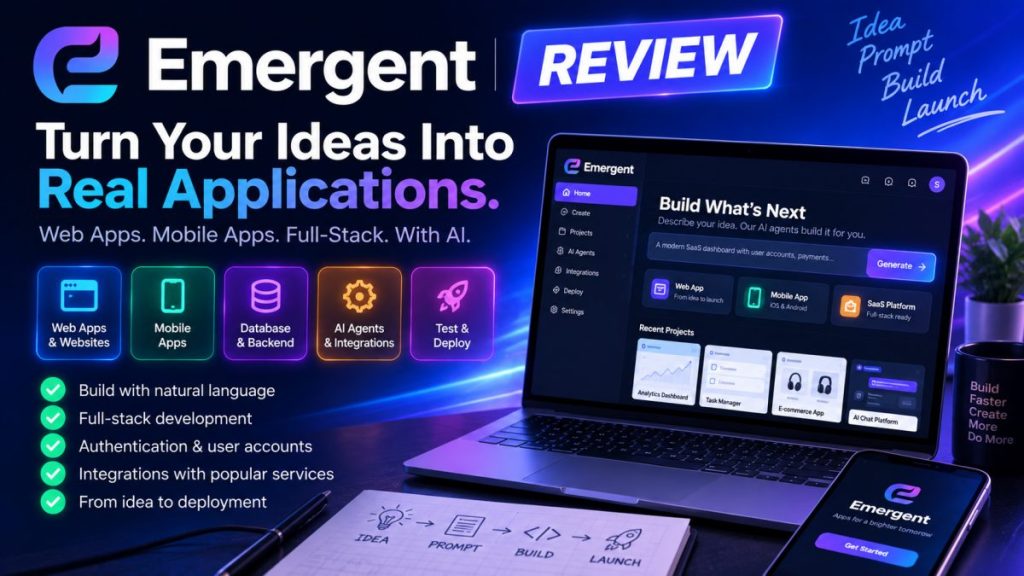
Emergent Review: Is This AI App Builder Worth It?

Building a web or mobile application traditionally requires more than just an idea.
You may need a designer, frontend developer, backend developer, database, hosting, authentication, APIs, testing and deployment infrastructure. Even a relatively simple application can turn into a complicated development project.
Emergent takes a very different approach.
Instead of starting with code, frameworks and development environments, you describe what you want to build using natural language. AI agents then help design, code, test and deploy the application.
That makes Emergent part of the growing wave of AI-powered “vibe coding” platforms designed to reduce the technical barrier between an idea and working software.
The important question is:
Can Emergent actually help you build useful software, or is it mainly a tool for quick prototypes?
Quick answer: Emergent is worth considering if you want to build websites, web apps, dashboards, SaaS products or mobile applications using natural-language prompts instead of traditional development workflows.
Its biggest advantage is that it attempts to cover much more than interface generation. The platform can work with the frontend, backend, database, authentication, integrations, testing and deployment.
The main limitation is that AI-generated software still requires testing, iteration and human oversight. The more complex the application becomes, the more important it is to understand what the platform is actually building.
Emergent at a Glance
| Feature | Emergent |
|---|---|
| AI Website Builder | Yes |
| AI Web App Builder | Yes |
| Mobile App Builder | Yes |
| Full-Stack Applications | Yes |
| Database & Backend | Yes |
| User Authentication | Yes |
| API Integrations | Yes |
| AI Agents | Yes |
| GitHub Integration | Available on selected plans |
| Testing & Deployment | Yes |
| Custom AI Agents | Available on Pro and higher plans |
| Free Plan | Yes |
What Is Emergent?
Emergent is an AI-powered application development platform designed to turn natural-language descriptions into working software.
Instead of manually writing every component, you explain what you want to build and the platform’s AI agents work through the development process.
That can include creating the interface, implementing application logic, setting up data structures, connecting external services and preparing the application for deployment.
The platform supports both web and mobile application development, making it broader than a traditional website builder.
The real question isn’t: “Can AI generate an app?”
It’s: “Can AI handle enough of the development process to make building the app significantly easier?”
How Does Emergent Work?
The basic workflow is surprisingly simple.
You start with an idea and describe it using natural language.
For example, instead of opening a code editor and deciding which framework to use, you might describe a project like:
“Build a customer dashboard where users can create accounts, view their orders, update their profile and contact support.”
The AI can then begin turning that description into a working application.
From there, you can continue the conversation and request changes.
For example:
- Change the navigation
- Add a new page
- Modify the dashboard
- Add user authentication
- Connect an API
- Add a database field
- Change the design
- Fix an error
- Add a new workflow
This conversational approach is the foundation of the Emergent workflow.
Building Full-Stack Applications
One of the biggest differences between Emergent and simple AI website generators is the focus on full-stack applications.
A modern application isn’t just a collection of pages.
It needs logic, data, authentication and communication between different components.
Emergent is designed to handle those layers rather than generating only a visual frontend.
This makes it suitable for projects such as:
- Customer portals
- Dashboards
- Booking systems
- Internal business tools
- CRM applications
- SaaS products
- Online directories
- Membership platforms
- Project management applications
- Mobile applications
The practical benefit is that you can describe the desired functionality instead of manually connecting every technical component yourself.
AI Website Builder
If your goal is simply to create a website, Emergent can also be used as an AI website builder.
You can describe the type of website you want and allow the platform to generate the structure, layout and functionality.
This can be useful for:
- Business websites
- Landing pages
- Portfolios
- Directories
- Service websites
- Event websites
- Online communities
- Product websites
Unlike a conventional template-based builder, the main interaction is based on describing what you want rather than selecting a predefined template and manually configuring every element.
AI Mobile App Builder
Emergent also supports mobile application development.
This expands the platform beyond traditional website builders and makes it potentially useful for entrepreneurs who want to turn an idea into an application without starting with a conventional mobile development environment.
Possible projects include:
- Community apps
- Booking applications
- Productivity tools
- Customer applications
- Educational apps
- Internal business applications
- Marketplace concepts
- Mobile SaaS products
The ability to describe screens, workflows and functionality using prompts can make early development considerably more accessible to non-developers.
Database and Backend
This is one of the areas where the platform becomes more interesting than a simple AI page generator.
Applications need somewhere to store information.
Users, products, orders, messages, bookings and other records all require a backend and database structure.
Emergent is designed to create and manage those components as part of the application-building process.
Instead of manually setting up every database table and connecting it to the frontend, you can describe what information your application needs and refine the result through additional prompts.
For someone who understands the business requirements but doesn’t have extensive backend development experience, this can remove a significant technical barrier.
Authentication and User Accounts
Many real applications require user accounts.
Emergent supports authentication workflows including email, OTP and social login options, as well as user roles and permissions.
This opens the door to applications where different users need different levels of access.
For example, a business application could have:
- Administrators
- Managers
- Employees
- Customers
- Guests
The ability to describe these requirements through prompts can make building access-controlled applications easier than implementing every authentication component manually.
Integrations and APIs
Modern applications rarely operate in isolation.
You may need payments, email services, external databases, analytics, CRMs or other APIs.
Emergent supports integrations with external services and APIs as part of the application workflow.
This is particularly useful for applications that need to exchange information with existing services.
Potential examples include:
- Payment systems
- CRM platforms
- External APIs
- Database services
- Email services
- Analytics systems
- AI models
- Third-party business tools
The ability to request an integration using natural language doesn’t eliminate the need to understand what the external service does, but it can significantly reduce the amount of manual implementation required.
AI Agents
Agents are one of the most important parts of the Emergent approach.
A conventional AI chatbot generally produces an answer and waits for another instruction.
An AI development agent can work through multiple steps toward a larger objective.
That might involve:
- Understanding the requirements
- Planning an implementation
- Writing code
- Working with files
- Testing functionality
- Finding errors
- Making corrections
- Preparing the application for deployment
Emergent has also introduced E3, an autonomous app-building agent designed to take a broader project brief and work toward a functional application with less step-by-step direction.
This is an important development because the value of AI development tools increasingly depends on how much of the overall task an agent can manage rather than simply how well it generates individual pieces of code.
Building SaaS Products
SaaS applications are one of the more ambitious use cases for the platform.
A SaaS product normally requires a frontend, backend, authentication, database, billing and deployment infrastructure.
Emergent specifically promotes SaaS application development as one of its use cases.
This can be interesting for entrepreneurs who have a product idea but don’t have the resources to immediately hire a development team.
For example, you could potentially build:
- Project management software
- Client portals
- Booking platforms
- Business dashboards
- Specialized CRM tools
- Internal workflow applications
- Subscription-based software
- Niche productivity tools
The important distinction is that creating the first version is only part of building a successful SaaS product. Security, reliability, scalability, user experience and ongoing maintenance still matter.
Emergent for Non-Developers
This is probably one of the platform’s most interesting audiences.
Someone can have a strong understanding of a business problem without knowing how to program.
Traditionally, that person would need to explain the idea to a developer or development agency before seeing a functional product.
With an AI app builder, the process can become much more direct.
You describe the business requirement, see the result and continue refining it.
This doesn’t mean technical knowledge becomes completely irrelevant.
Understanding databases, authentication, APIs and application architecture is still valuable, especially as projects become more complex.
But the entry barrier can be considerably lower.
Emergent for Developers
Developers may initially see AI app builders as tools designed mainly for beginners.
That would be too narrow a view.
For experienced developers, a platform like Emergent can also be useful for rapidly creating prototypes, internal tools and early versions of applications.
Instead of spending hours creating repetitive boilerplate, a developer can use AI to establish the initial structure and then refine it manually or through additional prompts.
This can be particularly useful when testing a business idea before investing significant engineering time.
GitHub Integration
GitHub integration is another important feature for developers.
It provides a way to connect projects with a familiar development workflow and makes the platform more relevant to people who want their AI-generated projects to remain connected to a source-control environment.
This is important because AI-generated applications shouldn’t exist as isolated black boxes.
Having access to the underlying project and a development workflow gives users more control over what they build.
Testing and Deployment
Creating an application is only half the job.
You also need to test it and eventually make it available to users.
Emergent includes testing and deployment capabilities as part of its development workflow.
The platform is designed to let users move from an idea to a working application without manually configuring every part of the traditional development stack.
That can significantly simplify the process for beginners and accelerate prototyping for experienced developers.
Pricing and Plans
Emergent currently offers several plans aimed at different levels of usage.
The Free plan provides a way to explore the platform without a paid subscription and includes a monthly allocation of credits.
The Standard plan is designed for users who want more application-building capacity, private project hosting and additional features such as GitHub integration.
The Pro plan is aimed at more serious creators and businesses and adds capabilities such as a larger context window, advanced reasoning, custom AI agents, higher monthly credit allowances and priority support.
Business and Enterprise options are available for organizations that need features such as team workspaces, role-based access control, SSO, audit logs, custom deployment arrangements and other organizational capabilities.
Because Emergent uses a credit-based system, the practical cost depends on how much you build and how complex your tasks are.
Important: don’t judge the cost only by the monthly subscription. For AI development platforms, the amount of work you perform and the number of credits consumed can be just as important as the headline plan price.
Emergent vs. Traditional Development
Traditional software development gives developers extremely detailed control, but it also requires considerably more time and technical expertise.
An AI development platform changes the starting point.
Instead of thinking first about programming languages and frameworks, you begin with the desired product.
A simplified workflow looks like this:
- Traditional development: requirements → design → architecture → code → testing → deployment
- AI-assisted development: idea → prompt → generated application → refinement → testing → deployment
The second approach can be considerably faster for prototypes and smaller applications.
However, traditional development still has important advantages for highly specialized, complex or mission-critical systems where complete control over architecture and infrastructure is essential.
Pros and Cons
Pros
- Build applications using natural-language prompts
- Supports web and mobile applications
- Full-stack development approach
- AI agents can handle multi-step development tasks
- Backend and database capabilities
- Authentication and user management
- API and third-party integrations
- Testing and deployment tools
- GitHub integration on selected plans
- Useful for both non-developers and developers
- Free plan available
- Suitable for prototypes and business applications
Cons
- AI-generated applications still require testing and supervision.
- Complex projects can require substantial iteration.
- Credit usage can become important as projects grow.
- Users with no technical knowledge may struggle with advanced problems.
- AI-generated code can require debugging and refinement.
- Platform dependency is an important consideration for long-term projects.
- Enterprise requirements may require higher-level plans.
Who Should Choose Emergent?
Entrepreneurs
If you have a software idea but don’t have a development team, Emergent can provide a way to turn that idea into a working prototype and potentially a usable product.
Solopreneurs
For people building businesses alone, reducing the amount of technical work required to create internal tools or customer-facing applications can be particularly valuable.
Product Managers
Product managers can use AI-assisted development to create functional prototypes instead of relying exclusively on static mockups.
Developers
Developers can use the platform for rapid prototyping, repetitive development tasks, internal tools and early-stage products.
Small Businesses
Businesses can create specialized applications such as dashboards, booking systems, customer portals and internal workflow tools without necessarily commissioning a traditional software project.
Who Should Consider Another Option?
Emergent may not be the ideal choice if:
- You require complete manual control over every part of the software stack.
- You are building highly specialized infrastructure.
- Your application has extremely strict technical or compliance requirements.
- You already have a development team with an established workflow.
- You don’t want your development process to depend on an AI platform.
- You only need a simple static website.
Is Emergent Worth It?
Emergent becomes more interesting when the alternative is not another website builder, but a traditional software development project.
If you simply need a five-page company website, there are many simpler solutions.
But if you want to create a dashboard, customer portal, SaaS application, booking system, internal tool or mobile app, the value proposition becomes much more interesting.
The biggest advantage is not simply that AI can write code.
It’s that the entire development process can start from a description of the product rather than from a blank code editor.
That can make software development much more accessible to people who understand what they want to build but don’t necessarily know how to implement it from scratch.
The Decision
Choose Emergent if…
You want to turn an idea into a working web or mobile application using natural-language prompts and want AI to handle much of the development process.
Consider another option if…
You need complete control over the technology stack, are building highly specialized infrastructure or already have a development workflow that doesn’t benefit from AI-assisted app building.
Bottom line
Emergent is more than an AI website generator.
Its focus on full-stack applications, AI agents, databases, authentication, integrations, testing and deployment makes it a much broader development platform.
For entrepreneurs, creators and developers, the most interesting part is the ability to move from an idea to working software without starting with traditional development tools.
The key is to treat AI as part of the development process rather than assuming that one prompt will produce a finished production application without testing or refinement.
Ready to build with Emergent?
Turn your idea into a working web or mobile application using AI-powered development tools.
Frequently Asked Questions
What is Emergent?
Emergent is an AI-powered development platform designed to build websites, web applications, mobile applications, dashboards and other software through natural-language prompts.
Can Emergent build full-stack applications?
Yes. The platform is designed to work across the frontend and backend, including application logic, databases, authentication and integrations.
Can I build a mobile app with Emergent?
Yes. Emergent supports mobile application development in addition to websites and web applications.
Do I need to know how to code?
No. Emergent is designed to let users describe applications using natural language. However, technical knowledge becomes increasingly useful when debugging complex applications or making advanced changes.
Does Emergent support databases?
Yes. Database and backend management are part of the platform’s full-stack application development workflow.
Does Emergent support APIs and integrations?
Yes. The platform supports connecting applications with APIs, payment systems, CRMs and other external services.
Does Emergent have a free plan?
Yes. Emergent currently offers a Free plan with a monthly allocation of credits, allowing users to explore the platform before moving to a paid plan.
Is Emergent good for SaaS applications?
Emergent specifically supports SaaS application development and can be used to create products involving user accounts, backend functionality, billing and other application features.
Is Emergent suitable for developers?
Yes. Developers can use it for rapid prototyping, internal tools, application development and AI-assisted coding workflows. GitHub integration is also available on selected plans.
Can Emergent replace a developer?
It can reduce the amount of manual development required for many projects, but it should not automatically be treated as a complete replacement for experienced developers. Complex applications still require testing, architecture decisions, security review and ongoing maintenance.
Build your next idea with Emergent
Explore the platform and see how far you can take an application using AI-assisted development.